
On Saturday 7 December 2019, women marched to protest against sexual harassment and patriarchal domination and to demand equal rights including the passing of citizenship to their children. The rally started on Bliss Street at 2:30 PM, moving towards downtown Beirut. At 5PM, at Riad El-Solh Square, participants accomplished the flash mob Chilean feminists initiated on 25 November outside the Supreme Court in Santiago on the International Day for the Elimination of Violence Against Women. I was standing facing the assembly among others including journalists, filming the global anthem “The rapist is you!” that went viral across the world. When the flash mob was done, I moved away from the crowd towards barbed wires down the Grand Serail to upload videos on my Instagram story. However, a small group asked me to go somewhere else because they wanted to photograph a tag written on the ground with the Serail in the background. So I walked towards the United Nations building, on the Southwestern corner of the square. Still busy with the videos I saw besides these people a man leaning towards the ground and igniting fire. At this precise moment, I thought he was part of the photo-with-the-grand-serail-in-the-backround company and that fire was included in their scenography. Within a fraction of second, what seemed fanciful became tragic. The man’s pant went into flames. People were shouting and trying to extinguish the blaze in an intense spread of panic. While ambulances arrived to evacuate the victim, a group of protesters altercated with the crew of a local television channel. The protesters were criticizing the media’s cynicism and voyeurism and didn’t want them to broadcast the incident. I filmed the quarrel without knowing precisely why. My mind couldn’t figure out if what happened was a stupid accident – which was impossible, jeans cannot burn so fast without being soaked with gasoline – or a suicide attempt. Earlier that week, three men killed themselves in gestures of despair within a catastrophic economic situation. Subsequent news reports alleged that the man, Ahmad Suleiman Arbidi had announced his dreadful intention earlier that day and that his comrades tried to dissuade him from doing so.
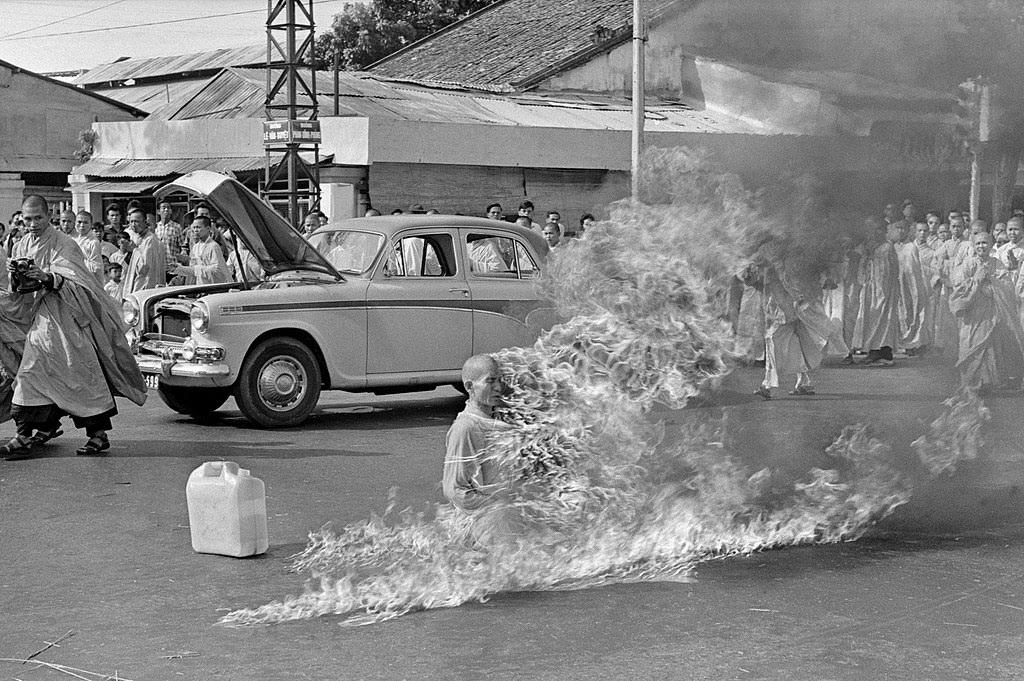
The infernal scene I saw reminded me the immolation of Thích Quảng Đức on 11 June 1963 within a context of protest against the persecution of Buddhist monks by the South Vietnamese government led by Ngô Đình Diệm. The day before, journalists received a memorandum according to which “something important” would happen. Malcolm Browne was among the few who showed up. He photographed the procession of monks, the arrival of Thích Quảng Đức and his burning. “I just kept shooting and shooting and shooting and that protected me from the horror of the thing”, said Browne. When Arbidi’s pants went on fire, I was standing less than twenty meters away from him, without any visual obstacle between us, holding my mobile phone, so that nothing technically prevented me from photographing or filming. Though I was completely petrified. Contrarily to me, it is probable that a professional press or documentary photographer or filmmaker would have handled the situation and shot the scene. Whether he or she should have disseminated the footage remains another question to which I have no answer.
Leaving this ethical questioning to forthcoming historians, it became obvious that the event we witnessed had more to do with Mohamed Bouazizi, a Tunisian street vendor whose self-immolation in Sidi Bouzid, on 17 December 2010, was the catalyst of the Tunisian Revolution and what became known as the Arab Spring. And even more with George Zuraik, who earlier in 2019 set himself in fire because he couldn’t afford anymore his daughter’s tuition fees. Zuraik’s death can retrospectively be seen as one of the prequel events of the revolution that started on 17 October 2019. Among the first pieces produced during the uprising is a drawing by the collective Bel.Mersad, depicting Zuraik and his daughter, with the following inscription (in Arabic): “George Zuraik burned himself on the date of 8/2/2019 in the playground of his daughter’s school. We wish you would have come with us burn tires and not burned yourself”.
On my turn, I wish the desperate – they will unfortunately be many, many, many – follow this advice.
Gregory Buchakjian
9 December 2019
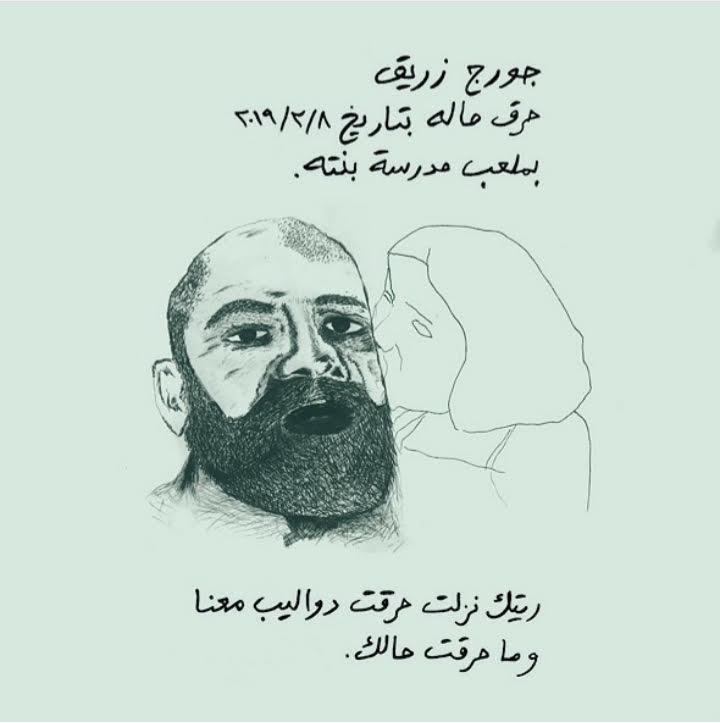
Image captions:
- Gregory Buchakjian, Altercation between protesters and television crew after the self immolation of Ahmad Suleiman Arbidi on Riad Solh Square, Beirut, 7 December 2019, film still
- AP Photo/Malcolm Browne, Thích Quảng Đức, a Buddhist monk, burns himself to death on a Saigon street 11 June 1963 to protest alleged persecution of Buddhists by the South Vietnamese government
- Bel.Mersad, Go down for George Zuraik, drawing posted on Instagram, 19 October 2019
 thethawrajournal.movie.blog