
AUTORITE / CRISE / INSURRECTION By Paola Faddoul
Il serait cliché de commencer ce projet de recherche par depuis « la création de ce monde », néanmoins en se penchant un peu plus sur l’Histoire de la terre et cet héritage que nous recevons à la naissance, nous ne pouvons que penser que l’histoire se répète de siècle en siècle : colère, rancune, haine, crises, révoltes, mots liés à l’Homme par des rites parfois sanglants. Notre évolution a été pavée par une violence répétitive et cela au nom de la liberté. Un mouvement de révolte contre l’autorité, le pouvoir politique qu’il soit étatique ou autre, qu’il soit tyrannique ou despotique, un mouvement commencé depuis l’antiquité et qui continue jusqu’aujourd’hui en France avec les « Gilets Jaunes », au Chili, à Hong Kong, et plus récemment au Liban et en Iran. Mais comme la si bien dit Georges Didi-Huberman : « Ou va donc la colère ? Soulèvement, insurrection, révolte : le feu de la colère suscite un évènement imprévisible, qui, entre fête et violence, entre allégresse et ressentiment, est toujours susceptible de bifurquer ou de se dévoyer, s’il n’est pas simplement écrasé ou canalisé par l’autorité contre laquelle il s’est dressé. C’est dire que révolte n’est pas synonyme d’émancipation »
Arrivés au XXIème siècle depuis presque une vingtaine d’années, nous vivons encore les mêmes problèmes que nos parents, les mêmes guerres nous suivent et hantent et il est bien triste de voir au pouvoir les mêmes personnes qui ont détruit peu à peu le pays, son présent et futur. Dans « les identités meurtrières », Amin Maalouf a très bien su décrire cette situation « L’avenir d’un pays ne peut pas être le simple prolongement de son histoire. ». Il est remarquable combien cette simple citation résume la situation récente du pays et cela est presque triste qu’on soit arrivé à ce stade de fatigue, frustration, colère, mépris et rancune, pour exploser à la fin avec une passion et un patriotisme étonnants tout autant que fascinants. Mais combien d’années avons-nous perdu ? combien d’années nous-ont-ils volé tel des sangsues affamées ?
Avec tellement de pensées, de questions différant pour chaque personne, nous ne pouvons ne pas se poser la question (dans ce cas-là une multitude peut-être) : comment ces évènements influencent-ils l’Art et l’image ?
Pour répondre à la première question, il serait intéressant de commencer « Le 3 mai 1808 » par Goya
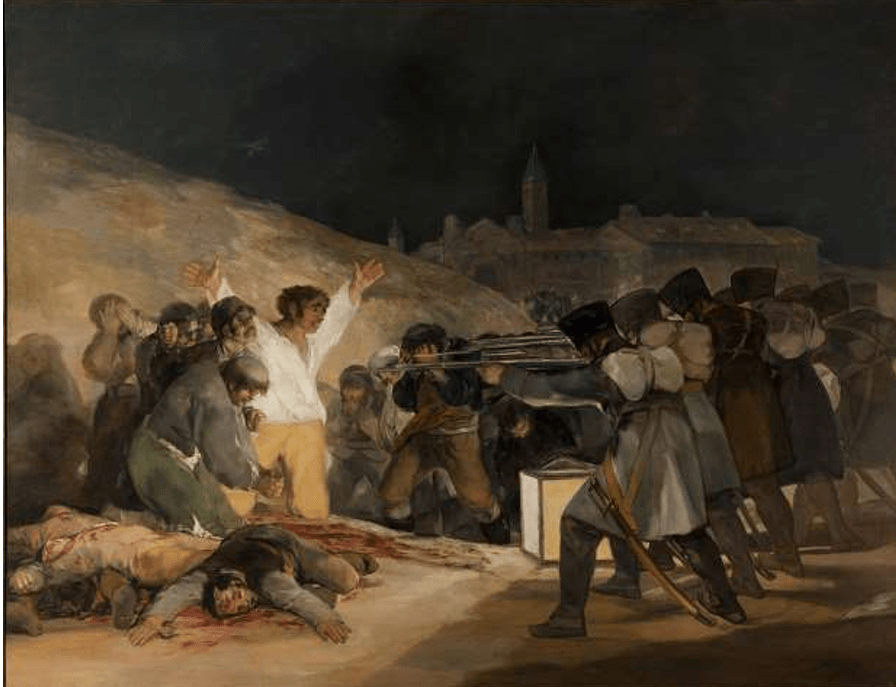
Le 3 mai 1808 (1814)
Francisco De Goya. Huile sur toile
268 x 347 cm Madrid, musée du Prado
Cette image choquante de Goya représente un événement réel – l’exécution à Madrid, par un peloton français, d’hommes du peuple coupables d’avoir apporté leur soutien à la rébellion contre l’occupation napoléonienne.
Goya recourt à des contrastes d’une efficacité redoutable, en traitant son sujet avec une expressivité spectaculaire, à la fois baroque et romantique, l’arrière-plan plongé dans l’ombre fournissant ainsi un décor effrayant à cette scène d’horreur puissamment éclairée. Les deux groupes de figures s’affrontent de très près : à droite, une rangée anonyme de soldats impériaux, tous penchés en avant, parfaitement alignés, leurs fusils dessinant un terrible et sinistre trait de mort. Leur raideur traduit leur nature d’automates et leur absence d’émotion quand à l’acte qu’ils s’apprêtent à accomplir. A gauche, les victimes en haillon forment une atroce procession : certains sont déjà morts, d’autres en position d’attente, d’autres encore marchent inexorablement vers un sort identique. Chacun est représenté de manière à provoquer l’empathie et la compassion chez le spectateur. Mais c’est l’homme situé au centre et vêtu d’une chemiseblanche, le visage grimaçant, levant les bras en geste de crucifixion, nous invitant à l’identifier a Jésus-Christ qui attire. Sa main droite porte clairement une marque semblable à un stigmate, soulignant son rôle de martyr et son identification avec le Christ, et cela renforce encore plus la position en croix du buste, prêt à recevoir les balles. Les nombreux ruisseaux de sang que les victimes déjà mortes répandent au sol forment un contraste saisissant avec le reste du tableau, peint en tons ternes et neutres. Seules autres exceptions, la chemise blanche éclatante er le pantalon jaune de la figure centrale sont éclairés d’une seule lampe brillante, pointée directement sur la victime attirant ainsi l’attention du spectateur sur la tragédie de sa mort imminente. Ce qui est troublant et remarquable dans ce tableau est la ressemblance avec les faits de la manifestation ou révolution libanaise. Le geste du martyr du tableau est le même utilisé par tous les manifestants libanais ainsi que son expression peinée retrouvée dans toutes les photos prises. Mais le plus troublant reste ce rappel du sang représenté par les flaques immenses entourant les martyrs espagnols, même flaque de sang entourant le martyr Alaa Abou Fakher mardi passé.
Ce même rappel et lien entre tableau et la révolution libanaise peut être trouvé dans « La liberté guidant le peuple »
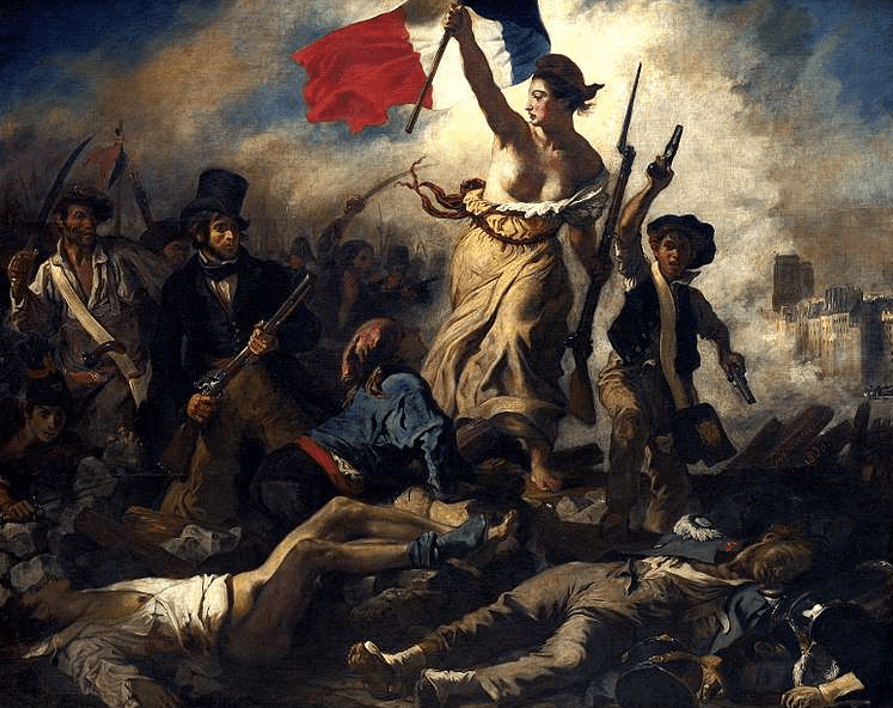
La Liberté guidant le peuple (1830)
Eugene Delacroix. Huile sur toile
260 x 325 cm
Paris, musée du Louvre Ce tableau, l’un des plus célèbres symboles de rébellion de toute l’histoire de l’art, a pour sujet l’insurrection parisienne de juillet 1830, qui chassa le roi bourbon Charles X pour le remplacer par Louis-Philippe, duc d’Orléans. Delacroix y représente un moment clé, celui ou les rebelles républicains percèrent définitivement les barricades, le 28 juillet. Le caractère spectaculaire de la scène est accru par la composition pyramidale ascendante qui en forme le cœur, dont le sommet est occupé par le drapeau tricolore qu’agite la Liberté et la base formée par plusieurs figures. Mais ce qui est remarquable est ce rappel entre la liberté et les manifestantes libanaises. Toutes ne montrent pas leur peur et restent courageuses, guidant le peuple vers une liberté du pouvoir régnant. Toutes deux femmes sans crainte, se positionnant au premier rang comme si elles guidaient, protégeaient le pays par leur force, leur délicatesse, leur endurance, leur volonté. Pour la première fois peut-être, la femme est montrée pour sa vraie valeur au Liban : protectrice, combattante, courageuse, aimante parfois blessante mais symbole de la liberté, symbole du peuple et symbole du Liban. Cette révolution est différente des autres par le rôle qu’on donne à la femme, par l’importance qu’on lui donne et enfin par le fait qu’il s’agit de la révolution des femmes. Toutes les manifestantes deviennent ainsi la Marianne, toutes un modèle de « La Liberté guidant le peuple »
Savons-nous ce que l’avenir nous offrira ? sommes-nous sures que tous ces efforts auront un résultat positif ? est-il si difficile d’espérer ? de rêver un peu ? de se dire que nous réussirons ?
Je conclurai par un extrait d’Amin Maalouf comme pour dire que ceci n’est pas la fin puisqu’un sujet pareil ne fera jamais parti du passé.
« En ce temps-là, le ciel était si bas qu’aucun homme n’osait se dresser de toute sa taille. Cependant, il y avait la vie, il y avait des désirs et des fêtes. Et si l’on n’attendait jamais le meilleur en ce monde, on espérait chaque jour échapper au pire »
STRONGER TOGETHER By Christina Nammar

Blinded By Jane Hachem
Corruption savoring our blood
Blind is leading the blind
Unaccomplished change
Manic behavior becomes the only choice
Divided we fall
But what happens when we Unite?
What if a corrupt system still remains the same?
Aveugle
La corruption savourant notre sang
L’aveugle dirigeant l’aveugle
Changement non accompli
Le comportement maniaque devient le seul choix
Divisés nous tombons
Mai que se passe-t-il quand on s’unit ?
Et si un système corrompu reste toujours le même ?
Jaywritings
By Yasmina Salame

Moment de ruptures, rupture de moments By Anonymous
Une routine, une répétition, un cercle vicieux, ou plutôt un cycle infernal, un temps si élastique qu’il en devient plat, infini, et puis, la rupture : un moment, celui ou tout bascule.
Et c’est comme ça, c’est toujours une question de moments, ceux qui nous définissent et définissent tout notre univers avec eux. Tout revient toujours à cet enfer temporel, à la fameuse frise sans queue ni tête, interminable. Et puis la rupture. On dit souvent que pour vivre dans un monde, il faudrait d’abord le fonder. Et un monde, ça nait en un moment, un éclat, avec le début d’une révolution.
Il y a des jours, des mois et même des années interminables, ou l’on a l’impression qu’il ne se passe rien. Et puis, il y a des minutes, des secondes, des moments qui contiennent tout un monde. Ces moments qui te coupent le souffle mais surtout, ceux qui te rongent les tripes. Ceux qui te bousculent et te transforment.
Et une minute a suffi, une seule minute, un seul éclat, un premier cri, une première explosion. Un simple moment qui a créé un nouveau monde, un monde dont j’ai envie de faire partie.
Un monde qui a pris la forme des moments qu’il m’a permis de vivre.
Des moments qui n’auraient jamais eu lieu dans cette torpeur dans laquelle baignaient mes journées.
Et cette révolution prend la forme de ces moments, ceux d’un nouveau monde, un monde alternatif ou tout est possible, un monde où nous serions les protagonistes de notre propre histoire.
Dans ce monde, nous sommes de nouveaux personnages, ceux que la révolution a modelés.
Et, je l’avoue, c’est une transformation.
Du silence aux cris, de la torpeur a l’action, de marionnettes à révolutionnaires. Ça nous a plus ou moins changés.
Et j’aime ces personnes que nous sommes devenues, elles m’ont permises de me retrouver.
Car, pendant cette révolution, en me battant pour lui, je me réconcilie avec le monde !
By Bavic

Autorité, Crises et Insurrections By Malek Nacouzi
« Lassalle a écrit un jour qu’il renoncerait volontiers à écrire tout ce qu’il savait s’il pouvait seulement réaliser, fut-ce partiellement, ce qu’il était capable de faire. C’est un Vœu que ne comprend que trop bien tout révolutionnaire. »
Trotski- Journal D’Exil, Premier Cahier.
La révolution, définie par le Larousse comme un « changement brusque et violent dans la structure politique et sociale d’un État, qui se produit quand un groupe se révoltant contre les autorités en place, prend le pouvoir et réussit à le garder », peut être vue sous un angle simple et étymologique comme une « nouvelle évolution » une re-évolution. Cette approche foncièrement évolutive du système politique permettrait de soulever la question des origines de cette insurrection. Quelle est l’origine de la révolution, où puise -t- elle ses racines ? Il sera question d’une suite logique de la création d’une révolution à travers d’abord l’infraction d’un droit légitime naturel qui mènera ensuite à une insurrection personnelle visionnaire, qui sera à l’origine de la création d’une image, symbole ou preuve irréfutable qui causerait un éveil des masses et enfin une révolution.
Les penseurs et théoriciens dit « jusnaturalistes » défendent la notion de Droit Naturel. Il s’agirait de l’ensemble des droits dit subjectifs, qui permettrait à un individu de légitimement avoir, faire ou exiger certaines choses. Le droit est d’ailleurs étymologiquement basé sur la notion de Justice (« dikaion » de « dikè » (justice) en grec), d’où cette notion actuelle de droit comme ce qui est juste ou conforme à la loi. Donc pour revenir à la notion de droit naturel, il serait question d’un élément « naturellement juste » ou même conforme aux lois de la nature. Enfreindre la loi, empiéter sur le droit « Naturel » d’un autre serait alors considéré et ressenti comme contre nature et donc « Injuste ».
Ce sentiment d’injustice, serait à l’origine d’un moment de crise intellectuelle (politique, philosophique, psychologique…). Ce moment de questionnement est normalement résolu par l’application de la loi. Pour Hobbes dans « Léviathan » abandonner sa liberté et conférer à une tierce personne (L’Etat) un pouvoir qui permettrait d’enforcer la Loi dans le but de s’assurer sa propre sécurité, donne la responsabilité à l’Etat de gérer une crise. Cela pose la question de la légitimité du Pouvoir, de la possibilité de le questionner et de le renverser. D’ailleurs, l’autorité prend sa base étymologique dans Auctoritas ; le pouvoir de faire grandir, la figure commanditaire d’autorité serait légitimement celle qui détiendrait le pouvoir de commander.
Or lors d’une révolution, l’élément subversif en force, c’est l’Etat. Comment faire alors confiance à une tierce personne corrompue détenant la liberté de tous, prenant, de plus en considération que cet élément subversif a lui-même été légitimisé par le peuple, principale victime d’un Etat corrompu. Cette salade psychologique, c’est elle qui est à la base de l’aliénation du peuple prérévolutionnaire.
Par exemple, la période insurrectionnelle à Paris désignée généralement par la « Commune de Paris » s’étendant du 18 mars 1871 jusqu’au 28 mai 1871 (après 7 jours de combats de rues que l’on réfère comme la semaine sanglante). Cette période voit naître un mouvement d’autogestion de la ville en réaction à l’élection d’un gouvernement de l’Assemblée Nationale au suffrage universel. K. Marx se référera à cette période comme première insurrection prolétarienne autonome.
« L’officier dit : Ne raisonnez pas, faites vos exercices ! »
Kant- Qu’est-ce que les lumières ?
Un esprit aliéné, n’est pas seulement soumis à un déphasage avec le monde, il s’agit de la « situation de quelqu’un qui est dépossédé de ce qui constitue son être essentiel, sa raison d’être, de vivre. » L’aliénation est ainsi un manque d’expression, d’extériorisation et de communication.
Pour subvenir à ce besoin d’expression, la réponse suprême d’un élément insurgé serait la création d’une image. De la rédaction d’un manifeste révolutionnaire à un tag sur les murs d’un parlement en passant par la fermeture d’une avenue principale d’une ville, un révolutionnaire impose un symbole, une image, un « statement » lourd de sens. Car l’image est l’ultime expression d’un moment. Une composition capturée et arrachée de sa 4eme dimension, le temps.
Comme l’aura dit Terry White, procureur lors du procès intenté contre les policiers ayant agressé Rodney King en 1991, à propos de la principale pièce à conviction de l’affaire (La vidéo de l’agression). « Cette bande vidéo montre alors de façon décisive ce qui s’est passé cette nuitlà̀. C’est quelque chose qui ne peut être réfuté. Tout le monde peut le constater. C’est l’élément de preuve le plus objectif qu’on puisse avoir. » L’approche de Terry White fait de la vidéo un symbole pour la communauté́ afro-américaine de l’époque qui manifestera pendant 6 mois pour enfin relancer le procès et criminaliser les policiers
“The telephone is a dangerous little instrument, unfit for diplomacy.”
Harold Nicholson- On Diplomacy, 1961.
Que dirait Harold Nicolson aujourd’hui. A l’ère de la création du moment pour l’image, où internet pousse à la sur-création de production de tout genre, où les réseaux sociaux nécessitent et recommandent une image qui accompagne tout texte pour légitimiser ce dernier. L’image est une preuve qui fait vibrer les masses, elle a un impact fort sur le ressenti d’un événement. Loi suprême du marketing, l’image du produit passe avant toute autre de ses caractéristiques. Ce qui nous emmène au dernier maillon de notre pensée : L’image, faute d’éduquer, sensibilise la foule, et donne à un moment un aspect précis, cadré, souvent composé et avec un parti pris.
L’invention et la création d’une Image est à l’origine de l’insurrection de masse. C’est la retranscription de la vision d’un individu révolté à travers cette image qui donne une direction à une révolution, un sens et un besoin de concret.
L’origine d’une révolution est liée à un sentiment de perte de sens, une aliénation totale qui, pour être contrecarrée, commande un besoin de concret, un impact sur le monde, une production expressive. L’image est à l’origine de la révolution de par son aspect universel, sa capacité à avoir un impact sur tout le monde.
Malek Nacouzi
Bibliographie : (M.L.A.)
➢ Fletcher, Tom. Naked Diplomacy. William Collins, 2016. ➢ Trotski, Léon. Journal D’exil, 1935. Gallimard, 1960. ➢ Kant, Immanuel. Foundations Of The Metaphysics Of Morals ; And, What Is Enlightenment?. Bobbs-Merrill, 1959. ➢ Monla, Myriam. “La « Crise De L’Autorité » Ou Les Prophètes De La Nouvelle Pompéi”. Journals.Openedition.Org, 2019, https://journals.openedition.org/sds/4298. Accessed 16 Nov 2019. ➢ HOBBES, THOMAS. LEVIATHAN. ANCIENT WISDOM PUBLICATIO, 2019. ➢ Tillier, Bertrand. La Commune De Paris, Révolution Sans Images ? Politique Et Représentations Dans La France Républicaine (1871-1914). Champ Vallon, 2004. ➢ Cours de Philosophie, M. Debbs, A. Abi Daoud, M. Hamouche – Jamhour Terminal, 2018 ➢ Grand dictionnaire Encyclopédique Larousse, éd. Larousse, tome 13, Lizy-sur-ourcq, 1985. ➢ 1 Histoire, 1 Image, and Cyrus North. “Le Passage À Tabac De Rodney King”. Youtube.Com, 2018, https://www.youtube.com/watch?v=Nf2cxK1dmZg&list=PLJ6RDhT0IVEBqixu_OiqSQ MOnBodkFRAg&index=2. Accessed 18 Nov 2019.
By Sabine Chaaya

By Cloe Hajjar
I wake up on the 27th day of my country’s revolution only to find it burning again…
I opened my eyes on the 4th week of my country’s awakening only to the sight of more blood…
After almost a month of my Lebanon’s rising, we all see it fall down and go back to square one.
Square one… did we even move? Or have we been just sitting there all along?
Square one! Burning tires, closed roads, empty promises, useless politicians, men down, widowed wives, orphaned children, passive soldiers, angry people…
Angry people… maybe not angry enough…
Ruins of Freedom? By Archxcam

What About By Karim Soufan
Yeah what about
What about
What about
What about the people
What about the children
What about the women
What about the ones who suffered all those years of pain
All those years of hell
All those years of tears
What about their voices
What about their thoughts
What about the ones who work all day long
Think all night long
What is next for us
What about the future
Are we gonna live?
We Are Peace By Christina Nammar

Je suis Libanaise By Shermine Warde
Je suis Libanaise
Je vis à Beyrouth
J’ai apprécié Beyrouth
J’ai gouté à sa douceur de vivre.
Par contre je n’ai pas vécu ce que mes parents ont vécu.
Je n’ai pas vu le Liban d’antan dont on me parle tout le temps.
Et je n’ai pas vécu toutes ces années de guerre, de combat.
Il faudrait peut-être souffrir pour comprendre la souffrance.
Mais j’ai 20 ans aujourd’hui et je me sens concernée.
Je dois le reconnaitre, j’ai un rôle à jouer.
C’est à notre tour de prendre la relève.
De se rassembler et de passer à l’action.
À la veille de Noël je suis triste.
Triste de voir cette misère régner.
Triste de voir des familles qui ne fêteront pas cette année.
Triste de voir toutes ces associations fermer leur porte.
Triste de voir que mon école, le Collège Notre Dame de Jamhour, ne pourra peut-être plus assurer sa mission.
Triste de voir ces milliers de personnes perdre leur travail.
Mais une seule chose est claire.
Nous sommes un.
Et depuis le 17 Octobre nous sommes encore plus unis.
Unis pour un Liban meilleur.
Le Liban de nos rêves.
Nous n’allons pas baisser les bras.
Dans la peine, ou la joie rien sur terre ne nous vaincra.
La véritable compassion est dans nos cœurs, dans chacun d’entre nous.
J’appelle donc chaque personne aujourd’hui
À venir en aide à son frère qui en a besoin.
À afficher un sourire sur son visage, lui qui baisse les bras.
À lui donner de l’espoir pour qu’il continue à tracer son chemin.
Ce chemin dont lui-même trouvera l’issue.
Et nous en serons fiers.
Fiers d’avoir écrit l’Histoire.
Fiers d’avoir fait de cette année 2019
Le début d’un nouveau départ.
Notre train a déraillé sur une route pleine de virages
Mais maintenant il s’en remet
Prêt à démarrer, vers un agréable voyage
By Andrew Azar

This is By Christel Abou Habib
This is for the country I dreamed of all along
This is for the people unified and strong
This is for the family that I always fought for
This is for the people of all shapes and forms
This is for the county that overcame all these storms
This is for all the expats that couldn’t stay and for all the taxes that we have to pay
This is for all the opinions that we were forbidden to say
This is for all the work that I can’t find in my domain
This is for all the poor people and the number is insane
This is for all the power that we will obtain
This is for all the artists: painters, actors, poets… who never got a chance
This is for all the happiest depressed people no matter the circumstance
This is for the villages that we want to preserve
This is for all the rights that we damn well deserve
And they had the nerve,
They had the nerve to call Lebanon theirs
This is for my Lebanon and for my revolution in every institution
By Ivan Debs

By Anonymous
‘I’ve been spending the last couple of weeks in the streets, and so I’ve been meeting the people that spend their whole life in the streets. But my heart got deeply touched by one of them. We laughed, we smiled together in the past few days, but today he was the one that wiped my tears away. There’s those people that we meet, sometimes we spend only few minutes with them, share just a conversation, and then their impacts are rooted in us for the rest of our lives. That ten year old boy is one of those rare people. And as we said to each other, we’re very happy that we’ve met. He saw me crying in a back street, he recognized me and cheered me up with his pure innocent heart. He hugged me and refused to leave before I stop crying. He was sad, he was truly sad to see me like that, and I started to wonder why. I still don’t know why. I was avoiding my friend, the crowd, I was all alone in this back street until he came, and then everything changed. I wonder what will happen when the revolution will be over, will I still get to see him on the streets?
But what I’m worried the most about, is that I know I will probably not be there for him if he cries, to cheer him up, and I wonder if there will be someone to comfort him the way he did with me.’
Tout nous appartient By Yasmina Salame

By Joy Yammine

I took this picture on the 20th of November 2018, while walking from Riad el Soleh to The Egg. I decided to post it today, after the 2nd month anniversary of our Thawra.
This was written in front of the old theatre. When I read it, it felt like one of those dreams we have but know they won’t come true, a dream so big that no one would even try to chase it. I thought about the person who wrote it, a person whose heart is full of anger and disgust over this country’s corrupt leaders, but who can’t find any other way to express himself, and to feel this sense of revolution, because I am sure that each and every one of us, this time last year, would have never believed that a revolution this beautiful would happen this year.
But miracles happen. They do.
When I look back at the past two month, I can’t help but remember the 18th of October, the first day I went to the streets, the day I realized how much this country really means to me and how much I have taken it for granted for the past 20 years. I can’t help but remember my mother’s smile when I took her with me to Martyrs’ square. The old man who I gave my flower to. Him telling me that I’m prettier than any flower out there. The little kid on his father’s shoulders. Ali playing with me next to the mosque. The women’s march. Climbing on the road signs. The candles. Riad el Solh. My friends dancing with the little kids in Downtown. The tetas. The Jeddos. Baabda. The morning cleanups. The songs. The ring. The “Ya3tik l 3afye”s. The daily walks to and from Gemayze. The speeches. The liars. The pigs. The corrupt pigs. The first time I went up on The Egg’s and the theatre’s roofs. My Thawra family. The rain. The suicides. The people. The sounds. The smells. The love. The martyrs. Every little detail. I can’t help but remember every fucking little detail. And I fall in love with our Thawra over and over again.
OUR Thawra. The people’s Thawra, the one everyone was waiting for. The one that lights a spark in everyone’s heart. The one that’s not allowing us to sleep at night. The one that’s showing us that there’s still a little hope and humanity in this world. The one someone was dreaming of since god knows when, and wrote ثورة in the heart of our country. A heart that’s been dead for so long and has been trying so hard to come back to life. And it did, it finally did, thanks to our Thawra.
So today I won’t wish our Thawra a happy 2 months anniversary, because our Thawra has been alive for so many years now in the hearts of the people who really love our Lebanon, and it just spread its wings 2 months ago.
So here’s to many more days and weeks and months and years of flying, till we reach the stars.
Baze2 By Nougature

By Tia Abi Ad
Le réveil est brutal. Pendant les premières secondes, il ne sent pas ses jambes. Puis il sent le sang venir doucement réveiller chaque membre de son corps. Ses yeux apprivoisent progressivement la lumière. Il bouge un doigt, puis un autre, il secoue une jambe, et tout à coup, se retrouve hors du lit.
Une nouvelle journée a commencé. Un énième soleil s’est levé, venant repousser les cauchemars de la nuit. Mais il lui suffit de refermer les yeux, ne serait-ce qu’un instant, pour que l’obscurité s’invite et convie ses cauchemars dans sa tête.
Il retrouve sa femme et ses enfants. Son fils mâche des céréales, les yeux fixés sur le portrait de son grand-père. Sa fille gémit, elle ne veut pas manger. Le petit dernier revisite le salon, disparaissant parfois sous une table, se cognant la tête contre les rebords du canapé. Sa fille crie à présent ; pourtant sa mère a été claire, si elle ne mange pas, elle ne peut pas regarder de dessins animés. Le bébé pleure, l’ainé hurle et appelle au silence. La maison toute entière se remplit de bruits divers. Des bruits quotidiens, familiaux et familiers, qui tentent de tarir le malheur sans jamais y parvenir.
Mais ces sons sont interrompus par le claquement d’une arme qui se recharge. Tout le monde se tait. Les enfants regardent leur père, leurs yeux disent « excuse-nous, père ». Le petit a cessé ses déambulations. Le grand baisse à nouveau le regard sur le portrait de l’aïeul.
Il pose son fusil sur la table sans dire un mot. Dehors, un coup de feu rompt le silence de la maison, et de tout le quartier. Un cri de femme résonne. La journée vient de commencer, les autres détonations suivront.
Oui, une nouvelle journée a commencé. Il pose une main sur l’épaule de son fils ainé. De l’autre, reprend son arme. Toute la famille a les yeux rivés sur le portrait à présent. Mais on ne compte plus les jours depuis que le grand-père est mort. On ne compte plus les jours depuis que Alaa Abou Fakhr est mort.
Une nouvelle journée a commencé. Le soleil, de plus en plus chaud, continue de se lever. L’air, de plus en plus lourd, sera, aujourd’hui encore, le terrain de balles perdues. La terre, de moins en moins ronde et de plus en plus creusée par les bombes, continuera de faire résonner les pas de ceux qui veulent venger leurs morts. On ne sait plus pourquoi on tire. On ne sait plus sur qui on tire. Les sanglots, de plus en plus forts, sont de plus en plus fréquentés.
Une nouvelle journée commence à chaque levée de soleil depuis novembre 2019. Et moi, où suis-je ? Quel âge ai-je atteint, l’ai-je atteint ? Il fait un peu froid, tout à coup…
By Laura Ghabris

Citoyens By Sana Ayass Khatcherian
Pour tout ce qu’ils sont, qu’ils soient maudits.
Pour tout ce que vous êtes, soyez bénis.
Pour vos sacrifices
Et pour vos larmes.
Pour votre courage
Pour l’exemple
Et la preuve par deux millions.
Pour la liberté déterrée
Pour la dignité exhumée
Et l’humiliation mise en terre.
Pour votre passion contagieuse
Pour votre énergie prodigue
Pour vos slogans impertinents
Et votre humour inépuisable.
Pour les vérités martelées
Pour vos graffitis grinçants
Pour vos banquets sur la chaussée
Pour vos nuits sur l’asphalte
Pour vos chants de courroux
Pour vos refrains qui rassemblent
Et pour vos danses sacrées.
Pour ces bêtes aux abois
Pour leurs gueules ahuries
Pour leurs ruses déjouées
Pour leur boussole qui s’affole
Et leur vision qui se brouille.
Pour votre audace capitale
Votre culot et votre irrévérence
Pour vos yeux pleins de foi
Vos poings levés
Vos mains tendues
Et vos corps boucliers.
Pour votre cœur au ventre
Votre cœur en écharpe
Votre cœur en bandoulière
Et pour nos cœurs en fête.
Pour votre détermination intrépide
Pour la poésie de cette Révolution
Pour nous dessiner des lendemains qui chantent
Pour ce Koullouna qui enfin nous ressemble
Et pour l’ivresse de ce Liban nouveau.
Pour la Fraternité sans frontières
Pour la Solidarité que vous enfantez
Pour porter notre rêve à bout de bras
Soyez bénis.
Beyrouth 19 novembre 2019.
By Yara Temsah

A wake up call By Thea Ghosn
I stopped counting. I don’t know which day of the revolution we are anymore. It’s as if I have gotten used to the idea that my country is bleeding, that my people are hurting.
From abroad, I am observing my land.
I see the artists, the lovers, the brave, the hopeful, the bloggers, the stubborn, the social media addicts, the extrovert and the helpers; I see the anxious, the hopeless, the skeptical and the depressed. All commonly being one thing: Fighters.
Thanks to these people, my new heroes, I know what it really is to be resilient. I know what it really means to be in Love with your nation.
But today I want to address the others. I want to mention the rest of my nation. I want to talk to those who still support the government, to those who still believe in a system that have smashed our country, our Lebanon.
I hear you say repeatedly that you have the same demands that we have but find it unfair to put everyone in the same box.
I tried to understand. I tried to look at things your way.
But why would we? Why would we try to find excuses to those who have directly or indirectly lead this one of a kind country to the lowest point possible?
I hear you argue between each other’s trying to defend the “less corrupted” or the one who has stolen the less. I watch you get angry and pissed at each other’s always referring back to the 70’s and the 80’s trying to find a solid ground to your thoughts and arguments. That is what you do best. You go back to history as if the solutions lie in the past.
If we have gotten to this very critical point, it is because you have been feeding your heroes with your cynical behavior towards one another. Their ultimate goal was to create unconditional tension between us. And you kept on repeating your mistakes. You keep on nourishing their ideology and implementing it in your children minds. Isn’t that a shame?
We are trying to build a country and all you do is ARGUE and spread fear.
I wholeheartedly ask you to put you beliefs aside.
Who holds the truth? We’ve been trying to figure it out for 30 years now. Such a waste of time.
Each one of us has his own truth, his own kind of self-agreements which helped him build his beliefs.
Understand that these truths you carefully hold on to are only perceptions and are only relative to your experiences and your education. Opinions, point of views, interpretations but nothing close to a truth.
I dare you to step out of your comfort zone and try to look at things differently. Try to detach yourselves from the past and from the civil war.
The day we are going to understand that it is all a matter of context, all a matter of what we have been taught and how we grew is the day we will be able to let go and all become children of Lebanon.
Hold our hands. Let us turn our arguments into discussions. Let us transform our conversations from a “who is right and who wins” to a “what is right and how can we save the nation”. Let us all become dedicated to our country and not to a political leader.Nothing could ever save us if we don’t choose to step out of this system.
Let go of those who were unable to prioritize between investing in basic wildfire equipment and investing in their own cupidity. Let go of those who have taken away our dreams.
Notes on un-shot images of an uncanny event By Gregory Buchakjian

On Saturday 7 December 2019, women marched to protest against sexual harassment and patriarchal domination and to demand equal rights including the passing of citizenship to their children. The rally started on Bliss Street at 2:30 PM, moving towards downtown Beirut. At 5PM, at Riad El-Solh Square, participants accomplished the flash mob Chilean feminists initiated on 25 November outside the Supreme Court in Santiago on the International Day for the Elimination of Violence Against Women. I was standing facing the assembly among others including journalists, filming the global anthem “The rapist is you!” that went viral across the world. When the flash mob was done, I moved away from the crowd towards barbed wires down the Grand Serail to upload videos on my Instagram story. However, a small group asked me to go somewhere else because they wanted to photograph a tag written on the ground with the Serail in the background. So I walked towards the United Nations building, on the Southwestern corner of the square. Still busy with the videos I saw besides these people a man leaning towards the ground and igniting fire. At this precise moment, I thought he was part of the photo-with-the-grand-serail-in-the-backround company and that fire was included in their scenography. Within a fraction of second, what seemed fanciful became tragic. The man’s pant went into flames. People were shouting and trying to extinguish the blaze in an intense spread of panic. While ambulances arrived to evacuate the victim, a group of protesters altercated with the crew of a local television channel. The protesters were criticizing the media’s cynicism and voyeurism and didn’t want them to broadcast the incident. I filmed the quarrel without knowing precisely why. My mind couldn’t figure out if what happened was a stupid accident – which was impossible, jeans cannot burn so fast without being soaked with gasoline – or a suicide attempt. Earlier that week, three men killed themselves in gestures of despair within a catastrophic economic situation. Subsequent news reports alleged that the man, Ahmad Suleiman Arbidi had announced his dreadful intention earlier that day and that his comrades tried to dissuade him from doing so.
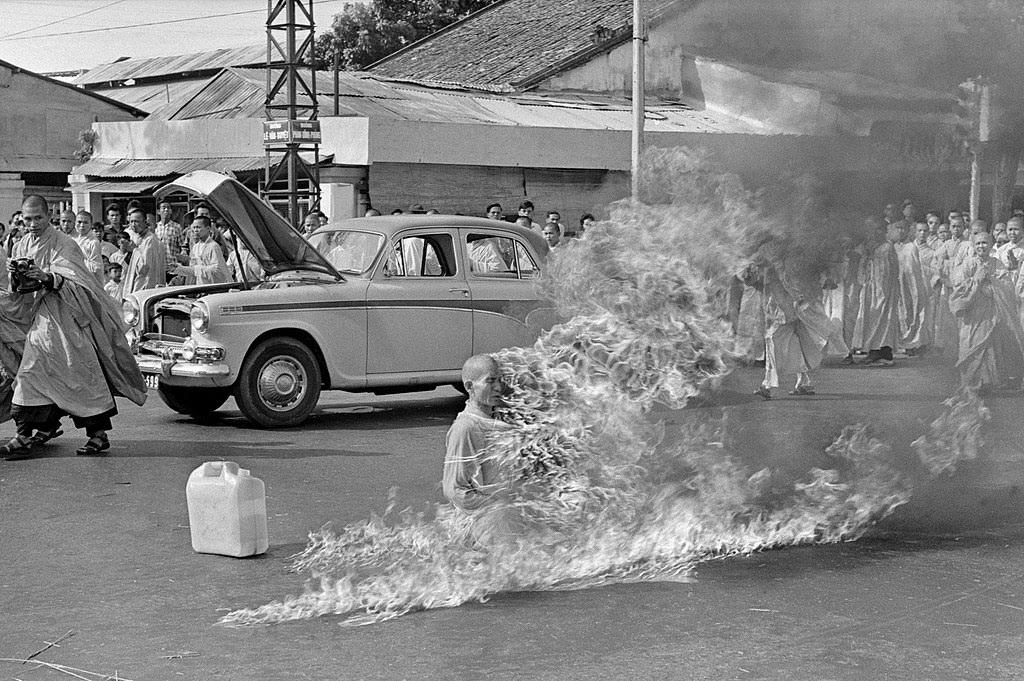
The infernal scene I saw reminded me the immolation of Thích Quảng Đức on 11 June 1963 within a context of protest against the persecution of Buddhist monks by the South Vietnamese government led by Ngô Đình Diệm. The day before, journalists received a memorandum according to which “something important” would happen. Malcolm Browne was among the few who showed up. He photographed the procession of monks, the arrival of Thích Quảng Đức and his burning. “I just kept shooting and shooting and shooting and that protected me from the horror of the thing”, said Browne. When Arbidi’s pants went on fire, I was standing less than twenty meters away from him, without any visual obstacle between us, holding my mobile phone, so that nothing technically prevented me from photographing or filming. Though I was completely petrified. Contrarily to me, it is probable that a professional press or documentary photographer or filmmaker would have handled the situation and shot the scene. Whether he or she should have disseminated the footage remains another question to which I have no answer.
Leaving this ethical questioning to forthcoming historians, it became obvious that the event we witnessed had more to do with Mohamed Bouazizi, a Tunisian street vendor whose self-immolation in Sidi Bouzid, on 17 December 2010, was the catalyst of the Tunisian Revolution and what became known as the Arab Spring. And even more with George Zuraik, who earlier in 2019 set himself in fire because he couldn’t afford anymore his daughter’s tuition fees. Zuraik’s death can retrospectively be seen as one of the prequel events of the revolution that started on 17 October 2019. Among the first pieces produced during the uprising is a drawing by the collective Bel.Mersad, depicting Zuraik and his daughter, with the following inscription (in Arabic): “George Zuraik burned himself on the date of 8/2/2019 in the playground of his daughter’s school. We wish you would have come with us burn tires and not burned yourself”.
On my turn, I wish the desperate – they will unfortunately be many, many, many – follow this advice.
Gregory Buchakjian
9 December 2019
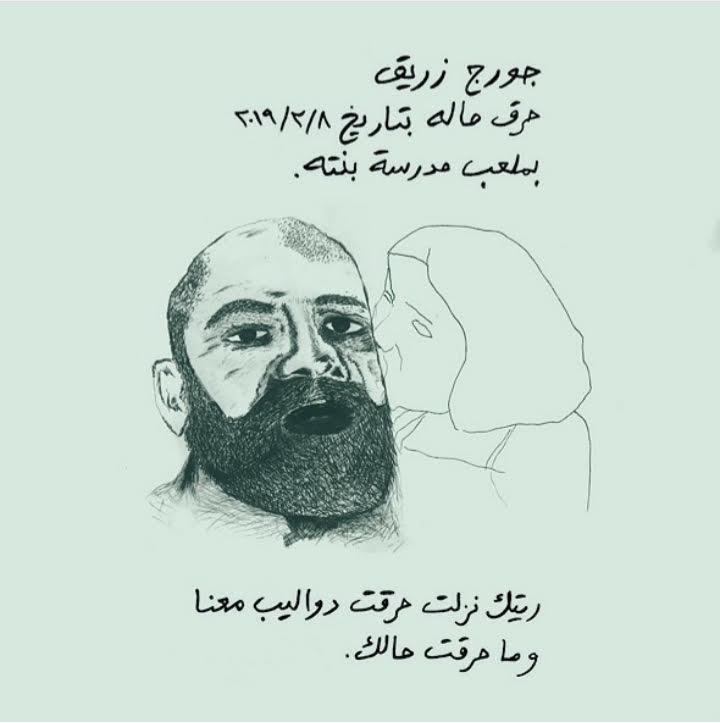
Image captions:
- Gregory Buchakjian, Altercation between protesters and television crew after the self immolation of Ahmad Suleiman Arbidi on Riad Solh Square, Beirut, 7 December 2019, film still
- AP Photo/Malcolm Browne, Thích Quảng Đức, a Buddhist monk, burns himself to death on a Saigon street 11 June 1963 to protest alleged persecution of Buddhists by the South Vietnamese government
- Bel.Mersad, Go down for George Zuraik, drawing posted on Instagram, 19 October 2019
By Diab Aly

Il a pris feu By Ghina Abboud

By Elias Chamoun
Sur les trottoirs de la rue de Gemmayze, je rencontrais souvent un homme, assis, qui regardait les passants aller et venir, les saluant parfois. La plupart des fois, cet homme prêchait ceux qui lui accordaient quelques secondes de leur temps, son discours fait l’éloge de Dieu, des saints, critiquant le Gomorrhe où nous sommes arrivés. Apparemment, il vivait au bord des escaliers de Saint Nicolas. Il dormait là-bas, son lit était constitué d’un simple carton où il mangeait parfois si un généreux passant lui offrait un petit sandwich de l’un des restaurants qui remplissent la rue. Sur son front, est tatoué « Jésus est le fils de Dieu ». De l’encre qui ne disparaitra jamais. Il a toujours un chapelet entre ses mains. Le sourire, toujours présent sur son visage. Un regard d’indifférence et d’insouciance émane de ses yeux. En le fixant, on remarque directement que sa raison d’être n’est plus, il vit, depuis longtemps, avec une aliénation permanente.
Qui sait ? Ce mendiant pourrait avoir été le témoin du meurtre de ses parents il y a 30 ans. Il pourrait êtretémoin de décapitations, de torture et de bien d’autres crimes.
Ou bien, au contraire, il pourrait être un ancien combattant, pourrait avoir vu des dizaines, des centaines, prendre leur dernier souffle, pourrait avoir été l’un des meurtriers de sabra et chetilla ou officier pendant la guerre sur un des barrages où l’on décapitait les gens pour leur simple appartenance à une confession ou à une autre. Il pourrait être Gilbert, ou l’amant de Gilbert, deux snipers de Beyt Beyrouth qui ont préféré l’amour à la haine et à la guerre.
Mais dans les deux cas, cet homme est victime d’une guerre sanglante. Meurtrier ou meurtrie, d’un côté ou de l’autre du fusil, les abominations sont les mêmes. Cet homme, comme Beyrouth, vit sur les cendres d’un passé qui les hantent. A chaque religion, son quartier, chaque religion, son « identité » qui transforme l’autre en étranger, qui fait naitre en chacun une peur de l’autre. Beyrouth a sombré le jour où ses fils se sont entretués au nom de leurs croyances en oubliant qu’ils vivaient dans des maisons mitoyennes et allaient aux mêmes écoles.
Telle est Beyrouth. Depuis la guerre jusqu’au 17 octobre 2019.
Depuis ce jour, Beyrouth a changé. Les gens ont changé. Beyrouth est guérie de la démence causée par ce flot de sang. Beyrouth renait le 17 octobre, se détache de ce passé, torturant son présent, et paralysant son futur. Elle peut désormais effacer le tatou collé sur son front et regrouper tous ses enfants ensemble. Beyrouth a compris, que chaque habitant de cette ville a les mêmes maux et les mêmes plaisirs. Beyrouth s’est épanouie, c’est une femme qui danse, sourit, porte une magnifique robe. L’automne 2019 est désormais son printemps.
Inheritance By Sarah Saroufim

Description: For the families of those we’ve lost because of a failed system
By Aya Khalife

Poem by Sabine Chaaya
18/10/2019
Je vous raconterai cette révolte, car j’y étais
Il y avait ces chants
Ces chants nés de notre fière demande d’exister,
de notre droit inatteignable à une vie décente,
Ces chants qui célèbrent un Liban éternel
Ces chants qui caressent nos peines.
Il y avait ces voix
Ces voix unies dans leur belle diversité
Il y avait ces visages
Ces visages parmi lesquels j’ai vu
Une tête haute, vidée d’insulte et digne de son deuil
Le deuil du ce Liban, ce rêve, ce parfum
J’ai vu des inconnus, loins de moi, loins de ma culture
Dans leurs yeux, les armes jettées
Dans leurs sourires, la gratuité
Je vous ai raconté cette révolte.
Je ne vous raconterai pas le Liban d’antan, car je n’y étais pas.
Ce que nos parents disent être tellement différent
De la corruption et du vol que l’on voit maintenant .
J’aurais voulu noircir mes pieds à force de marcher dans ses villages
Écrire et peindre infiniment l’histoire de son peuple, lui rendre hommage
Alors je vous raconterai, pour qui veut l’entendre, cette révolte
Pas celle d’aujourd’hui, celle de plusieurs décennies
Car cette rage, je l’ai dans mon cœur
À chaque fois que je vois la médiocrité irradier
Que je touche du doigt leur superficialité
À chaque fois que l’on ravage nos forêts
Et que l’on fait taire notre identité, sur nos terres ou à l’étranger
À chaque fois que l’injustice affiche son visage carnassier
Car elle se moque de vous, vous dont les yeux sont fermés
Par un filtre sensationnel caché sous le nom de fidélité
“Il a sauvé mon père, donc je le suis”
Obsolète est cette réflexion, mais souvent la raison est-elle piétinée par l’émotion
Je me révolte contre vous qui défigurez et dissimulez la réalité
Ils vont raconterons, eux, ce qu’elle est.
Eux.
Le peuple.
Il crit. Il chante. Il est là.
Descendez dans les rues.
Je vous raconterai cette révolte, car j’y étais
Je vous raconterai cette révolte, car elle est en moi, elle est en nous
Alors craignez notre combat
Le temps de la justice est là
Texte Anonyme
C’est une ligne fine, la révolution. C’est un fil solide mais translucide que l’on essaye de suivre. On force nos yeux à le percevoir, oui, après tellement d’années, on en arrive à forcer nos cerveaux à voir l’évidence même, on est poussés par l’espoir à prendre contrôle de différents sens dans nos corps afin de les obliger à faire face à la réalité : nous nous révoltons.
Mais, à 20 ans, ce n’est pas facile d’avoir un élément étranger à ton corps te pousser au réveil. Une révolution catalyse ta perception, et, soudainement ce coma dans lequel tu vivais, ce coma inné à ton être, t’es arraché. Cette perte est agréable pourtant, ça fait plaisir de savoir qu’à un certain moment, on dit non à ce traitement digne de bétail, mais, on en pense quoi de cette perte quand cela fait 20 ans que ta patrie c’est ton monde dans ta tête ?
On grandit, les années passent, la situation du pays, désastreuse qu’elle est, s’immisce lentement dans notre conscience, elle y prend forme, elle lui donne forme. On compare avec nos amis à l’étranger, on se demande, pourquoi pas moi ? je n’ai pas le droit d’être traité avec respect ? et le fil des idées nous entraine, il nous pousse au loin, il atteint une terre vierge, s’y plante et puis perd progressivement sa couleur. On se retrouve alors sur une autre planète, un espace que l’on a nourrit, d’amour, de joie, de chagrin, de colère, de mélancholie, d’une vie quoi… et ce beau jour arrive où quelque chose secoue le fil et te demande de le suivre. 20 ans de vie vécue en limbo, 20 ans de désir et de besoin de quitter et puis on nous réveil. Jamais je n’ai ressenti un mélange aussi intense et symbiotique de joie et de tristesse. Heureux que 20 ans d’exil soient pratiquement annulés par ce contre-courant à la misère que l’on vit mais triste de quitter mon rêve, triste de quitter ce monde de rêverie vers sa réalisation, sa concrétisation. On n’en parle pas assez, mais, il y a une douleur qui sous-tend la réalisation des plus beaux des rêves. A nous, alors, de se tenir par la main et de dire « tu n’es pas seul sur ce chemin sauvage, tiens-moi la main et attrape ce fil, à deux, on voit mieux. »
By Thea Chammas
Today marks the end of the 4th week of the Revolution. It’s been 29 days.
Since day one, I’ve had so many things to say, and couldn’t find the words to. But I’m gonna try.
Three years ago, I left Lebanon to study abroad. Before that, I was counting the days until I’d leave it. I hated Lebanon. I hated its people, its narrow-mindedness, its politics, its corruption.
I arrived to a big city with big dreams. I met a lot of people who all seemed cultured, educated and open-minded. It felt so good. I got easy access to education, to healthcare, to transports, to telecommunication, to public spaces, to my rights, as a woman, as a human. Everything seemed like the future. It wasn’t. It’s just the way things are supposed to be. Civilized.
Time passed, and I started to miss Lebanon. I started to miss its food, I started to miss its weather, I started to miss my comfort zone, I started to miss the warmth of the people, I started to miss its music, I started to miss my friends. I started to miss my family.
Time passed, and I actually started to enjoy going back to Lebanon for holidays. But then again, I kept telling myself: “Lebanon is amazing for holidays, but I could never live here forever again.” And you know what the worse part is? The worse part is, I didn’t even realize how wrong that was. Why would someone who likes his country never want to live in it? In its own country! I guess I had really lost all hope.
Then, on Monday 14th of October 2019, I was on my way to class when I first read about the fires burning all over the country. It broke my heart. I spent the day on my phone, trying to follow the news, hoping the fires would stop, not understanding why we didn’t have more tools to extinguish them. However, I was very moved by the solidarity of Lebanese people in these hard times.
On Wednesday 16th of October 2019, I was talking to a friend that was in Lebanon, and I said:
“I don’t understand why people aren’t all protesting already. Everybody hates the government and nobody is doing anything about it. It’s driving me insane.”
She just answered: “ It’s useless. Everybody is complaining on social media, but no one is willing to do anything about it.”
On Thursday 17th of October 2019, I was having dinner with some Lebanese friends living in the same city I do. One of them left the table and only came back half an hour later. When he came back with a totally shocked face, I made fun of him. Until he said: “Guys, you’re not gonna believe what’s happening. My uncle just called from Lebanon. People are protesting on the streets. A revolution is starting.”
You can only imagine my face when I heard that, only one day after the conversation with my other friend.
I didn’t know how to feel about this.
I was excited and happy but scared and stressed at the same time.
I said: “It’s not gonna last, people are gonna protest for a day or two and that’s it.”
But I kept following the news 24h/24h. Deep down, I was truly wishing the protests wouldn’t stop, at least not until things changed a bit.
The distance was heartbreaking. I spent my days following what was going on through social media. I couldn’t work, I couldn’t socialize, I couldn’t sleep. I was constantly tied to my phone. And for once, it was for a good cause.
For the first time in my life, I’ve felt proud to be Lebanese. For the first time in my life, I’ve had hope for my country’s future. For the first time in my life, I’ve thought: “If things change, I wanna live in Lebanon forever.”
I couldn’t be there instantly, but my soul was constantly with my people and my country. As the days passed, I started to realize this was something big. I cannot count the times I had to hold my tears in class, in the subway, in a bar… while watching a video showing unity, love, support, awareness amongst Lebanese people. It was the most beautiful and unbelievable thing I’d ever seen.
I needed to go back to Lebanon.
I felt useless. I felt like I had failed my country. I felt like I abandoned it. This revolution had always been my dream, and I couldn’t even be there to see it come true.
Despite my parents being doubtful about it, I took plane tickets to go back home as soon as possible to fight for my country, with my people. I just couldn’t bear the heartbreak of knowing all that was happening, not being there, and not even being able to talk about it with foreigners because I’d seem annoying, overly patriotic, or they would just don’t care.
For the first time, I went to the airport, really excited to go back home. When the plane took off, I cried. When we landed, I cried even more. Seeing Lebanese people all around me never felt so good, so comforting.
Although I’ve been going to every protest abroad, it wasn’t the same. So I headed right after I landed to the streets. The Lebanese streets. The streets that were filled with hope, anger, and ambition. Walking in Beirut never felt so good. The people. The generosity. The hospitality. The art. Revolution never looked so good.
I talked to army soldiers, they thanked me for coming all the way to protest and were begging us to keep protesting, because they can’t. I cried. Again. I told them I could only be there for 5 days, so there wasn’t anything to thank me for, I thanked them, and asked them to keep the people safe. They promised they would, as much as possible.
And so I spent 5 days protesting, seeing things I never thought I would, meeting people I never thought could exist, feeling a power I never thought I could feel.
I’ve always been quiet nihilistic. Nothing never made much sense to me. Everything was pointless in the end. But for the first time in my life, it wasn’t. For the first time in my life, I felt hope. My perspective on everything changed in only five days. My perspective on art changed, my perspective on politics changed, my perspective on people changed, my perspective on every other country in the world changed, my perspective on Lebanon changed. In only five days, my perspective on life changed. In only five days, I’ve learned more than I did during the rest of my life.
The following days, while I was protesting, a man called my name from a distance, I turned away, and I saw one of the army guys I had met the other night, coming to me only to say hi. Out of all faces, he recognized me. Out of all names, he remembered it. Then, a bit further, I saw all his friends that I had also talked to, and they all waved hands with a huge smile on their face to say hi. It may seem like nothing, but it made my day.
The week I was in Lebanon, some peaceful protestors were attacked by some guys supporting a certain political party. It broke my heart. How could you just attack people who’ve been fighting for their dreams for the last two weeks, and destroy everything they built?! How could you be so evil? Two hours after the attack, the protestors were already building everything all over again, and fighting for their country. It was beautiful.
Leaving Lebanon had never been so hard.
I cried, once again, when the plane took off, and when we landed. Since then, I’ve been back to following the news 24h/24h through my screens. My eyes are dried, my nerves are tired, but I can’t help it. I cannot bring myself to do anything else. Everything else seems pointless. The only ideas I get at college are about the revolution, all my art is being about the revolution, all my writing is being about the revolution. It’s like I found something meaningful in my life, for once. I’m not a religious person, but everything that’s been happening have really been like a religion to me: it made me wanna be good to others, it made me wanna help others, it made me wanna love others, it gave me hope for the future, even on the bad days of it all, it still fueled me with hope. And if that isn’t a religion to you, your definition of a religion is wrong.
4 weeks later, our government still haven’t managed to solve it all. I know things take time, but when will they wake up? Will they even ever really wake up? Through all the love and joy, I still was sane enough to see and be disgusted by how careless our government is. They don’t care about us. Not even a bit. And for those who think they do, tell me: does your political chief even know you personally exist? What has he personally done to you? How does it feel to support someone despite it all who isn’t even aware of your existence, and won’t ever, EVER, do anything to help you personally through hard times? Tell me: if you were about to fall off a cliff, do you think your political chief would run to help you, or would it be another Lebanese citizen? Let that sink in. Because all we got is each other. As Lebanese. Not as religious people, not as politically oriented people. Dear people still supporting any political party, have you got access to water, electricity, decent WiFi, food, education, healthcare, public spaces, public transportation, all the time? Does your wife, your daughter, have all her rights as a woman? Is your air fresh, your sea clean, and your land green? If so, then go on with supporting your political party, but if it is so, we must be living in two different countries, or at least 2 different illusions.
Wake up. They don’t care about you. They just use you as tools to stay empowered. You are puppets.
Wake up. The same people have been governing for more than 30 years.
Wake up.
Whatever the president’s intentions were, at no point, AT NO POINT IN A DEMOCRACY, is he allowed to invite his people to leave their own country. THEIR country. Let me take this back. We’re not his people. We are the Lebanese people. And we are no one’s people but each other. And we are free. Seeing the President’s speech from abroad really broke my heart. “If people aren’t satisfied with any of the decent leaders let them immigrate.” Really? Seriously? Don’t you see most of us already did? And you know what? More than ever, you make us wanna come back home to fix all the wounds you and your colleagues did to our country. Maybe you’re the one who should me emigrating, dear Mr.President. Because you know what emigration feels like, right? You must know what homesickness feels like. You must know what being away from your loved ones feels like. You must know. Unless you’re really heartless. Unless you’re really a monster. So how dare you say that? How dare you?
A man lost his life following your speech. A kid saw his dad die right in front of him. A woman saw her husband die right in front of her. Children lost their dad. A family’s life have changed forever. A family’s gonna have the same nightmare all over again for the rest of their lives. A family’s whole psychology is changed for the rest of their lives. For what? This could have been avoided. It was free violence. It was inhumane. Every time I went through social media today and saw something about it, I’d end up tearing up. The worse part is, I can’t do anything about it. I can’t do anything to help. Last night, i couldn’t even sleep because of the fear of not knowing what would happen next. Fearing a war could begin at any moment, and not even being with my family, with my friends and loved ones.
Is this a joke to you Mr.President ? Is this a joke to any of you filthy pigs pretending to govern our country when all you do is ruin it and turn it to ashes? You’re all a disgrace to humanity. Monsters with no souls and no feeling. How could you let all that happen? Do you know anything about empathy? Because it seems like you don’t, and it’s about time you learned a little lesson.
Imagine all this happening to you. Imagine not having permanent access to water, to food, to electricity, to a way of communicating, to transportation, to warmth during winter, to education, to healthcare, not having MONEY (bet that one scared you the most, right? You filthy money-eating machines). Imagine swimming in the sea, amongst the ordures of thousands of people you don’t even know, instead of swimming in your own pretty private swimming pool. Imagine seeing your dad dying in the worst possible way right before your eyes. Imagine having nightmares of it for the rest of your life. Or the other way around. Imagine your wife seeing you die in the worst possible way right before your eyes. Imagine your family, the days after, the months after, the years after, struggling to survive in this jungle called Lebanon. Just imagine. Just put yourselves in their shoes for one second. It only takes one second.
Dear Mr. President, dear Government, I doubt any of you wants that.
Actually, no human being wants that.
Dear Mr.President, dear Government, is it really blood and death that you want?
Dear Mr. President, Dear General,
When in the army, your vows were to fight for your country, fight for Lebanon, fight for your people. Not against it.
Where do you stand now?
Also, to the Lebanese people not hitting the streets, not joining the protests, what’s your excuse? We still have so much work to do. If you got lucky enough not to suffer from all these issues throughout your life, it doesn’t mean you can’t fight for your fellow Lebanese citizens to have the same luck you did. Remember, if you were to ever fall off a cliff, who would help you?
Another Lebanese citizen, just like you. If you would hold and hang on to their hand, I’m sure you can do that now too.
Dear Mr. President, dear Government, dear people still following any political party,
You are a disgrace to human’s rights. You are a disgrace to humanity. You are a disgrace to Lebanon. You are the filthiest scums in this world.
Prove us otherwise
Shore insurgence by Sara Abi Merched

Shore Insurgence
The project is creating a home for a biologist on the verge of the sea in Anfeh.
With these ongoing events… Constructing on public properties was a line I could not pass.
So for the representation I said:
We are not machines
We have the power
The people have the power.
What’s my power as an architect?
As architects we always take into consideration many aspects and perspectives: the site the client the program the lighting and others
But we must always ask ourselves: who am I? And what do I want people to feel through my work?
The most important aspect of all is the era we are living in. These transitional times we are experiencing.
So what I say is:
I refuse to participate in the rape of public properties.
The change is within our institutions
The change is within
We will not go back to normality.
So I’m changing this project and the ground it was founded on.
Requestioning the project and its program was primordial.
Injecting what’s public into the new project and banning the private and personal functions was a must.
Redefining the program;
The laboratory and the cerebrum are places of culture and intellectual connection, exposing researches and information concerning the marine science, a place of work and knowledge where biologists and therapists and people of different backgrounds and perspectives can exchange their info.
Creating a place to make people feel the era we are living in and in the future become the memorial of reclaiming public spaces.
The receptions becomes places of enculturation and fraternization.
The cinema is a public / open place for a self-sufficient area to portray the revolution but also for public usage
The exertion is the replacement of the gym that is mental and physical effort combining.
The sop is the place where people can give and get depending on their needs and demands.
And the sop is what really all this project about
Giving something of no value to people demanding their rights.
This project is a fraction, an initiative of what can be done and achieved.
Basing on the analysis of the site, i decided not to differentiate myself volumetrically but also assuming the act of construction so for starters i take the rock aspect and patterns and recreate my volumes as rocks going thru erosions but also elevate these volumes thru the pixels that play many roles but the most important one is connecting. This idea of multiples pixels between a place and another the rocks and the water, between the rocks themselves, the “salines” between themselves was the foundation of the idea of the usage of the pixels. They can be structural, programmatical, connecting spaces by being the source of transition, connecting two volumes and connecting the exterior to the interior. They play even a role in the function that show the era we are in, an era of change an era of revolution.
After going for +30 days on the streets, screaming and growling i found it hard to go back into normality to go back into what was before. Who are we when we distance ourselves from our consciousness, when we distance ourselves from our authenticity to our passion?
I believe that we all want change, we all thrive for it, but are we willing to accept and go thru the consequences of these changes?
Are we brave enough?
Sara Abi Merched
Hopelessness by Jane Hachem
Hopelessness
“Masculin féminin”, or “un homme qui dort” or even “la chinoise”. Movies with sentences that make yourself wonder. Are you hurting? Are you isolating yourself from every single thing surrounding you?
Lies intensifying
Cries with a mix of hopeful smirks
Screams getting louder
Silent tears
But an obvious fear
It might be all over soon but a mark will remain whether it is visible or not, physical or just engraved in your so cold hearted self
We are all leaving somehow perhaps some not just mentally
We are getting out of this misery one step at a time,
Each one its own path.
I won’t be holding your hand along the way
Because you once told me you couldn’t
Do I remind you of past nightmares?
Nightmares that are in reality desires, fantasies, love, lust and hope.
You are one and I two.
But this time it is not only the system’s dirty work
But also our decisions
A decision you take when you don’t feel like being connected to this person anymore nor feel its existence ever again.
Let them vanish off of their useless thrones like we both vanished from each other’s lives.
Let them remain powerless because
What is power without control?
What is control without respect?
Jaywritings
By Karel Kargodorian

 thethawrajournal.movie.blog